Gameaton’s mission is to provide the best possible video game recommendations through a motivation-based approach. But motivation is far from the only way to recommend games.
In this experiment, I compare several recommendation systems available to players, which I believe are representative of the approaches currently available: Gameaton, Steam, 50GamesLike, SteamPeek, Games.gg, Nodal, and ChatGPT.
Methodology
To avoid bias toward games where Gameaton excels, I selected six titles spanning different ranks on Steam250 (as of September 10, 2026):
1: Stardew Valley
50: Stray
100: Bongo Cat
150: Blade and Sorcery
200: Farming Simulator 19
250: Plague Inc: Evolved
For each engine, I evaluated its top 5 recommendations. For ChatGPT (free version), I used a fresh temporary chat with the prompt:
“Give me your top 5 game recommendations that you think are the most similar to <game_title>“
Each platform receives a score out of 5 points per game:
1.0 pt: Strong match to the core experience.
0.5 pts: Partial match (close, but misses key elements).
0.0 pts: Poor match or game missing from the platform’s database.
Methodological Limitations
This is an exploratory experiment rather than a formal scientific benchmark. Keep a few context points in mind:
Subjective Matching: Games were scored based on matching the overall experience. Players seeking a specific mechanic (e.g., farming visuals vs. social sim in Stardew Valley) might evaluate matches differently.
Raw Outputs Only: I only evaluated initial recommendations. Unique platform features (e.g., Gameaton’s motivation filters, SteamPeek’s unreleased games, or custom sorting) were excluded.
Sample Scope: Selecting top 5 recommendations is a practical compromise for manual scoring, not a definitive statistical cutoff.
1. Stardew Valley

What are players really looking for when they search for something like Stardew Valley? A farming simulator, certainly — but a cozy one, with a nostalgic feel thanks to its retro aesthetic. It offers many different ways to play, a touch of economy and rewards for cultivating crops, and plenty of creative freedom when it comes to designing your farm.
As the first game on the list, Stardew Valley might be expected to be an easy case for recommendation systems. And indeed, 24 of the 35 recommendations are relevant across all platforms.
Several games appear multiple times, including Coral Island, Fields of Mistria, Roots of Pacha, and Sun Haven.
Interestingly, the worst-performing system here is SteamPeek, which may perhaps be better optimized for less well-known games. 50GamesLike, meanwhile, recommends a lot of 3D games. While they are generally in the right thematic territory, this contrasts with Gameaton, which recommends many 2D games.
Games.gg seems to lean more toward the “Animal Crossing” side of the experience, but its recommendations still broadly fit what a player looking for a Stardew Valley-like experience might want.
Steam, unsurprisingly, performs poorly. Without spoiling the results, this will remain a recurring pattern throughout the experiment.
2. Stray

Stray is a 3D adventure and exploration game that puts the player in the paws of a cat wandering through a dystopian city filled with robots. The game was a huge success when it was released, with seemingly the entire internet wanting to experience what it was like to be an adorable cat.
Unfortunately, recommendation systems struggle much more with this particular experience, with a combined score of just 12.5/35.
ChatGPT is the clear standout here.
One possible explanation is that the game’s success has generated a large amount of available data, giving an AI such as ChatGPT more information from which to draw comparisons between experiences.
3. Bongo Cat

Bongo Cat is the kind of game that takes up very little space on your computer screen and accompanies you while you work or perform other tasks, without demanding your full attention.
This is a very different type of experience from the other games in the experiment, and the recommendation systems seem to reflect that. Across 30 recommendations, 19.5 points were awarded, with almost all of the weaker recommendations coming from Games.gg and Steam.
4. Blade and Sorcery

Blade and Sorcery is a VR game in which the player uses weapons and magic to defeat enemies. The experience gives the player a great deal of freedom in a highly immersive environment.
The recommendation scores are not bad here, with the exception of Games.gg, which does not reference the game at all. Across the platforms that do, there are 22 correct recommendations out of 30.
50GamesLike falls somewhat behind, mainly because it proposes a number of experiences that are not VR.
This is an interesting case because the VR aspect is arguably one of the defining characteristics of Blade and Sorcery. A game can therefore be similar in terms of its combat or fantasy setting while still offering a fundamentally different experience because it is played in a conventional 2D environment.
5. Farming Simulator 19

I was a little disappointed when I saw that the fifth game was Farming Simulator.
I already knew that many recommendation systems would probably suggest other Farming Simulator games from different years. And, after all, they are technically correct: these games do offer a very similar experience.
But is that really what a player is looking for when asking for game recommendations?
Once again, Games.gg does not reference the game, while the other recommendation systems perform fairly well, with a combined score of 20.5/30.
Gameaton and Nodal recommend the other Farming Simulator titles, as expected. ChatGPT and SteamPeek try to diversify their recommendations, with fairly successful results.
50GamesLike, on the other hand, performs very poorly here — even worse than Steam.
This is also a good example of the difference between similarity and usefulness. Recommending another game from the same franchise is arguably one of the safest possible recommendations, but it may not necessarily help a player discover something new.
6. Plague Inc: Evolved

Plague Inc. is a strategy game about spreading a virus with the goal of wiping out the entire human population. It has a very distinctive feeling: a calm, calculated form of domination played out across a world map, with active pausing.
It is also the least “popular” game in the Steam250 selection used for this experiment, although it remains a very well-known title.
Could this explain why the overall scores are somewhat lower?
With a combined score of 17/35, perhaps. As with Stray, it may also simply be the result of a game that is sufficiently atypical to offer a fairly unique experience.
The results are fairly average across the different recommendation systems, with the exception of Steam, which once again performs poorly.
Overall Results
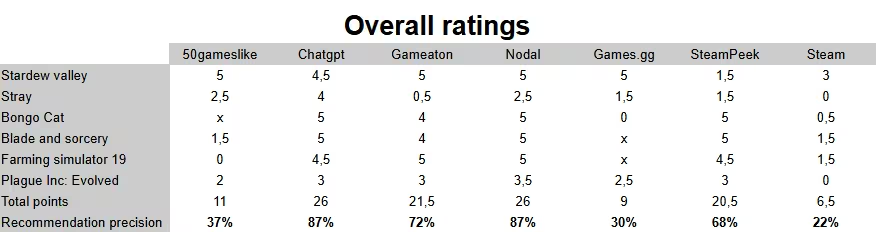
Overall, Gameaton unfortunately does not come out on top. It scores 21.5 points, placing it third overall.
ChatGPT and Nodal tie for first place with 26 points, while SteamPeek comes in fourth with 20.5 points.
The two leading approaches are based on statistical methods: purely through an LLM in ChatGPT’s case, and combined with user tags in Nodal’s case.
SteamPeek, which to my knowledge relies primarily on a tag-based approach, comes slightly behind. However, it shows promise in some cases and can lead to some interesting discoveries.
There are also several advantages offered by each recommendation system that are not reflected in this scoring system.
Gameaton provides similar games while highlighting differences in motivation. SteamPeek can recommend games that have not yet been released. Games.gg, Gameaton, and ChatGPT can recommend games outside of Steam.
Those are meaningful differences in terms of how these systems can actually be used, but they fall outside the scope of this particular comparison.
I may run this experiment again using less mainstream games. The statistical approaches used by Nodal and ChatGPT may reveal more of their limitations when dealing with games for which less data is available.
What does this tell us about game recommendations?
First, it is difficult to trust Steam’s recommendations. They are often surprisingly far from the experience of the game being searched for.
More broadly, approaches based on “players like you also liked” do not seem to work particularly well for video games when they are not combined with other signals. Steam and Games.gg both achieve relatively poor scores in this experiment.
A purely tag-based approach, such as 50GamesLike, also seems to have clear limitations. When tags are weighted, as with SteamPeek, the results improve.
By mixing tags with “players like you also liked”, the results are even better. This is the approach used by Nodal.
For Gameaton, the main takeaway from this experiment is that I should consider incorporating “players like you also liked” data into a future update. The results from Nodal and ChatGPT suggest that this additional signal could provide meaningful value alongside the existing approach of ranking games by motivations.
No platform currently manages to produce recommendations that hit the mark 100% of the time.
Different recommendation systems can complement each other. One of the most interesting findings from this experiment is that when the same title is recommended by two different systems, it is almost always a strong match.
In fact, 19 of the 23 recommendations that appeared more than once were perfect matches, scoring 90% accuracy on the points system (20,5 points on 23).
That suggests that recommendation systems do not necessarily have to agree all the time to be useful, but when two fundamentally different approaches converge on the same game, that agreement itself may be a powerful signal that the recommendation is worth checking out.