Classic Sudoku similar games & best alternatives
Should you play it?
Presented by Cracking The Cryptic, YouTube's most popular Sudoku channel, this is the brand new “Classic Sudoku” game that their viewers have been requesting for the last two years!
What works
- Handcrafted, challenging puzzles
- Excellent learning tools and hints
- Clean, intuitive interface
- Progressive difficulty curve
- Good value for price
Things to keep in mind
- Limited puzzle count (40-100)
- No multiplayer or social features
- High cpu usage reported
- Lack of audio and visual flair
- Some ui features could be improved
What to play next
Similar games, hidden gems, and fresh directions from this game.
Top picks
Games that feel the closest overall


Hidden Gems
Less popular games with surprisingly high similarity
If you liked…
Recommendations by what you enjoyed most
Similarity map
Explore nearby similar games and see why they’re close.
Classic Sudoku: Less representative of its motivational profile, with noticeable differences. Motivations that often define this kind of title include Violence, Fantasy, Story, Thrill. It leans lower than usual among comparable games on Fantasy, Sensation, Story.
Why this game works
A motivational profile of the game, with the closest similar game for each player motivation.
-
Autonomy
Game with the same Autonomy vibe
4"Players freely choose how to solve puzzles, with multiple approaches and modes allowing self-directed play."
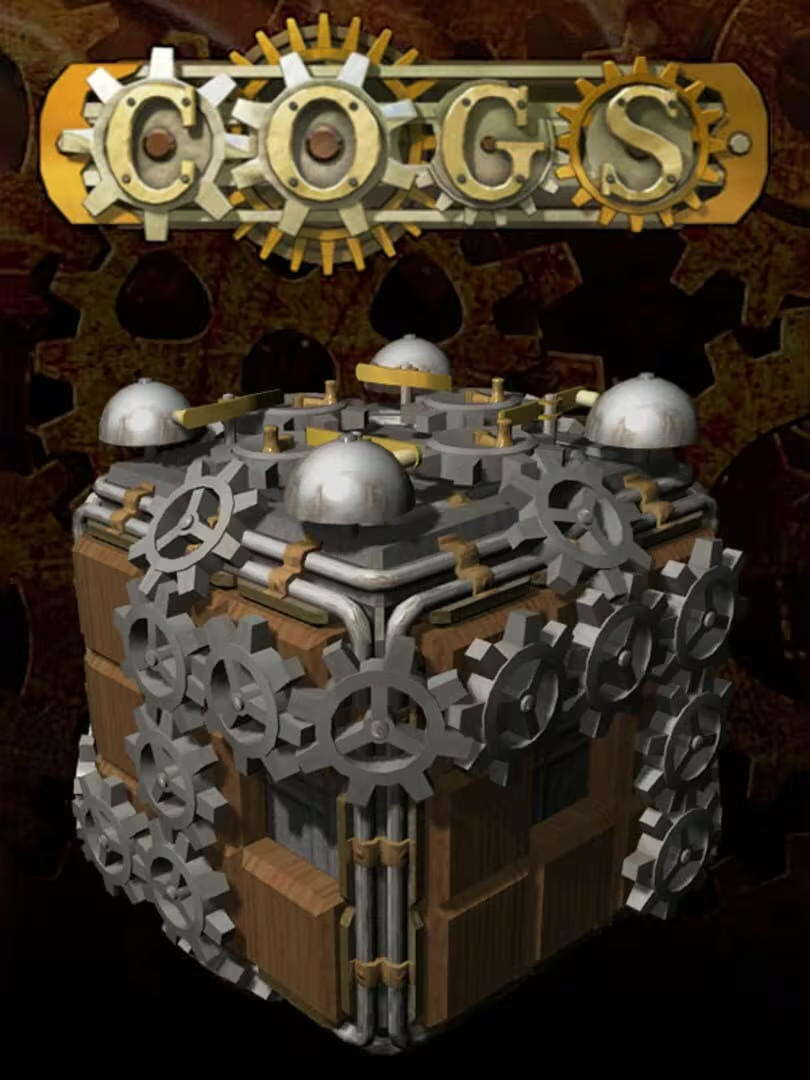 Cogs
Cogs
"Players freely choose puzzles to solve and use various tools and notations to direct their own solving process."
-
Competence
Game with the same Competence vibe
5"The game offers a steep learning curve with challenging puzzles and precise controls, rewarding skillful play and mastery."
 Road to Ballhalla
"Game offers a steep learning curve with advanced techniques and handcrafted puzzles that challenge and improve player skill."
-
Competition
Game with the same Competition vibe
-3"Focus is on individual puzzle solving and personal progress rather than competing against others."
 Mimic Logic
"Focus is on individual puzzle solving and personal improvement rather than competing against others."
-
Continuation
Game with the same Continuation vibe
3"Players report long play sessions and repeated retries on difficult puzzles, indicating sustained engagement."
 Delicious! Pretty Girls Mahjong Solitaire
"Players report long play sessions and repeated engagement with puzzles and learning techniques."
-
Cooperation
Game with the same Cooperation vibe
-5"Gameplay is entirely single-player and independent."
 A Little to the Left
"Gameplay is entirely single-player and independent."
-
Creativity
Game with the same Creativity vibe
2"Players create their own notes and strategies to solve puzzles, though the game content is predefined."
 Nancy Drew®: Curse of Blackmoor Manor
"Players can customize notes and markings, but puzzles themselves are fixed handcrafted content."
-
Domination
Game with the same Domination vibe
-5"No social dominance or power over others; purely individual puzzle solving."
 Q.U.B.E. 2
"No social dominance or power over others; purely personal puzzle solving."
-
Escapism
Game with the same Escapism vibe
3"Players use the game as a relaxing mental challenge and distraction from daily life stress."
 Logic Bombs
"Players use the game as a relaxing mental challenge and distraction from daily life."
-
Expectation
Game with the same Expectation vibe
-4"Players engage voluntarily out of personal interest and intrinsic motivation to learn and improve."
 Just Go
"Players engage voluntarily out of interest and intrinsic motivation to improve skills."
-
Experimenting
Game with the same Experimenting vibe
4"Players explore new puzzle mechanics and combinations, experimenting with rules and strategies."
 The Artisan of Glimmith
"Players explore new solving techniques and experiment with different notation and marking strategies."
-
Exploration
Game with the same Exploration vibe
-2"Puzzle environments are abstract and consistent; discovery is about logical patterns rather than new areas."
 Hexcells Infinite
"Limited spatial exploration; focus is on discovering logical patterns within fixed puzzles."
-
Expression
Game with the same Expression vibe
2"Players express themselves through coloring choices and use of tools, though within predefined images."
 Coloring Game: Little City
"Players can express solving style through use of colors and different pencil mark notations."
-
Fantasy
Game with the same Fantasy vibe
-5"Game is grounded in realistic logic puzzles without fictional or imaginative elements."
 Picross Touch
"Game is grounded in realistic logic puzzles without fictional or imaginative elements."
-
Fellowship
Game with the same Fellowship vibe
-4"Minimal social interaction; community exists mainly around modding and discussion rather than in-game social play."
 Cold Waters
"Minimal social interaction; community mainly through external channels like YouTube, not in-game."
-
Growth
Game with the same Growth vibe
5"Strong emphasis on learning rules, developing logical reasoning skills, and personal improvement."
Logic Bombs
"Strong emphasis on learning new techniques and improving logical reasoning skills."
-
Health
Game with the same Health vibe
-4"Sedentary experience with no physical activity involved."
 NEKOPALIVE
"Sedentary mental activity with no physical exercise component."
-
Idle
Game with the same Idle vibe
-3"Requires focused attention and sustained mental engagement rather than casual or background play."
 Tametsi
"Requires focused attention and sustained mental effort rather than casual or background play."
-
Intimacy
Game with the same Intimacy vibe
-5"No close social or emotional relationships formed through gameplay."
 Jurassic World Evolution
"No close social or emotional relationships formed through gameplay."
-
Leadership
Game with the same Leadership vibe
-5"No leadership or group management roles; purely individual play."
 Universe Sandbox
"No leadership or group management roles; purely individual play."
-
Progression
Game with the same Progression vibe
3"Players progress through increasingly complex puzzles and unlock new components and challenges."
 SHENZHEN I/O
"Players progress through increasingly difficult puzzles and unlock new content."
-
Relaxation
Game with the same Relaxation vibe
3"Many players find the game relaxing and mentally stimulating without undue stress."
 Puzzle Dimension
"Many players find the game relaxing and mentally engaging without stress."
-
Sensation
Game with the same Sensation vibe
-2"Minimal sensory stimulation; simple visuals and subtle sound effects without intense sensory input."
 Wordle 3
"Minimal sensory stimulation; interface is clean and simple without flashy effects."
-
Status
Game with the same Status vibe
-4"No social status or recognition systems within the game."
 KARAKARA
"No social status or recognition systems within the game."
-
Story
Game with the same Story vibe
-5"No narrative or story elements; purely puzzle solving."
 Pixel Puzzles 2: Birds
"No narrative or story elements; purely puzzle solving."
-
Strategy
Game with the same Strategy vibe
5"High emphasis on logical reasoning, planning, and abstract problem solving."
 Recursed
"Heavy emphasis on logical reasoning, planning, and problem solving."
-
Thrill
Game with the same Thrill vibe
1"Some thrill from solving difficult puzzles and breakthroughs, but overall controlled and cerebral experience."
 Bombe
Bombe
"Some players experience mild thrill from solving challenging puzzles, but overall controlled experience."
-
Value
Game with the same Value vibe
4"Players perceive good value for money due to engaging puzzles, story depth, and replayability."
 Rusty Lake Paradise
"Players perceive good value for money due to handcrafted puzzles and learning opportunities."
-
Violence
Game with the same Violence vibe
-5"No violence; gameplay is constructive and intellectual."
 Chess Ultra
"No violence; gameplay is constructive and intellectual."
-
Survival
Game with the same Survival vibe
-5"No survival or failure avoidance mechanics; stable puzzle environment."
 TIS-100
"No survival or failure avoidance mechanics; puzzles are stable logical challenges."
Last update: 01/06/2026