Fire & Maneuver similar games & best alternatives
Should you play it?
The Armchair Historian brings you a new turn-based strategy game set in the Victorian Era. As muskets become rifles and infantry is confronted by modernizing artillery, it is imperative to adapt to a rapidly changing battlefield. This is a new age, not of courage and chivalry, but of Blood and Iron.
What works
- Unique simultaneous turn-based tactical system
- Historically accurate and immersive victorian era setting
- Deep strategic gameplay with high skill ceiling
- Engaging campaigns and faction variety
- Passionate development team and community
Things to keep in mind
- Bugs and technical issues remain
- Small and inactive multiplayer player base
- Steep learning curve and limited tutorials
- Ai can be weak or inconsistent
- Performance and optimization problems
What to play next
Similar games, hidden gems, and fresh directions from this game.
Top picks
Games that feel the closest overall
Hidden Gems
Less popular games with surprisingly high similarity
If you liked…
Recommendations by what you enjoyed most
Similarity map
Explore nearby similar games and see why they’re close.
Fire & Maneuver: Broadly representative of its motivational profile, with a few distinct shifts. Motivations that often define this kind of title include Competition, Fellowship, Status, Cooperation. It leans lower than usual among comparable games on Fantasy, Intimacy, Domination.
Why this game works
A motivational profile of the game, with the closest similar game for each player motivation.
-
Autonomy
Game with the same Autonomy vibe
4"Players have control over their jumps, aiming, and strategic decisions in a unique turn-based simultaneous action system."
 J-Jump Arena
"Players have significant control over issuing orders and planning maneuvers with a unique simultaneous turn system requiring anticipation and personal decision-making."
-
Competence
Game with the same Competence vibe
4"The game rewards skillful planning, strategic thinking, and mastering complex mechanics with clear feedback on performance."
 Solium Infernum
"The game rewards skillful maneuvering, strategic planning, and mastery of complex mechanics with a high skill ceiling and meaningful feedback."
-
Competition
Game with the same Competition vibe
3"Multiplayer is competitive with ranked matches and skill-based play, though some players also enjoy casual or cooperative modes."
 Warhammer® 40,000: Dawn of War® - Dark Crusade
"Multiplayer is a core feature with player-vs-player battles and strategic mind games, though the player base is small and matches often require coordination."
-
Continuation
Game with the same Continuation vibe
3"Players report long play sessions and habitual engagement, though some mention bugs and early access state as drawbacks."
 Executive Assault 2
"Many players report long play sessions and habitual engagement, with some spending hundreds of hours despite bugs and early access status."
-
Cooperation
Game with the same Cooperation vibe
2"Some multiplayer modes involve team play and cooperation, but much gameplay is focused on individual strategy."
 Age of Empires® III (2007)
"Some multiplayer modes support team play (e.g., 2v2), but overall the game emphasizes individual command and personal strategy."
-
Creativity
Game with the same Creativity vibe
2"Players can customize armies and use various unit combinations and strategies, though unit design is somewhat uniform."
 Ashes of the Singularity: Escalation
"Players can customize army compositions and experiment with different formations and tactics, though within predefined historical units."
-
Domination
Game with the same Domination vibe
-3"Interactions emphasize balanced strategic play and mutual respect rather than dominance or trash talk."
 Strategic Command: World War I
"The game fosters balanced strategic competition rather than dominance or trash talk; interactions emphasize mutual respect and skill."
-
Escapism
Game with the same Escapism vibe
3"Players use the game as an immersive historical tactical experience and distraction, enjoying deep engagement with the era."
 Pike and Shot : Campaigns
"Players use the game as a historical immersion and distraction, enjoying the period setting and tactical challenges as an escape."
-
Expectation
Game with the same Expectation vibe
-4"Engagement is driven by personal interest, nostalgia, and voluntary play rather than obligation or pressure."
 Snood
Snood
"Engagement is driven by intrinsic interest in history and strategy rather than obligation; many players express personal passion."
-
Experimenting
Game with the same Experimenting vibe
4"Multiple factions, strategies, and political/economic systems encourage experimentation and trying new tactics."
 Dune: Spice Wars
"The simultaneous order system and varied factions encourage experimentation with tactics and learning through trial and error."
-
Exploration
Game with the same Exploration vibe
1"Some discovery in maps and strategic possibilities, but mostly familiar territory with known mechanics."
 Supremacy: 1914
"Some discovery in learning mechanics and historical scenarios, but limited geographic exploration as battles occur on fixed maps."
-
Expression
Game with the same Expression vibe
1"Limited character customization; some cosmetic variety in armor and weapons but no deep avatar personalization."
 Achilles: Legends Untold
"Limited cosmetic customization; some appreciation for unique unit voices and faction aesthetics but no deep avatar personalization."
-
Fantasy
Game with the same Fantasy vibe
-4"Strong emphasis on historical accuracy and realistic WWII tactical combat rather than imaginative fiction."
 Battle Academy
"Strong emphasis on historical accuracy and realistic 19th century warfare rather than imaginative or fictional elements."
-
Fellowship
Game with the same Fellowship vibe
1"Community exists but multiplayer is limited; social interaction mostly in small groups or friends."
 The Guild II Renaissance
"Community exists but is small; multiplayer requires external coordination (e.g., Discord) limiting spontaneous social connection."
-
Growth
Game with the same Growth vibe
4"Players develop skills, learn complex mechanics, and improve over time; steep learning curve but rewarding progression."
 Fairytale Fables
"Players develop strategic thinking, learn complex mechanics, and improve skills over time, with a steep but rewarding learning curve."
-
Health
Game with the same Health vibe
-5"No physical activity involved; typical sedentary computer gameplay."
 Shieldwall
"No physical activity involved; typical sedentary computer gameplay."
-
Idle
Game with the same Idle vibe
-3"Requires focused attention and planning during turns; not designed for casual or background play."
 Tactical Breach Wizards
"Requires focused attention during turns and planning; not suited for casual or background play."
-
Intimacy
Game with the same Intimacy vibe
-4"Social interactions are mostly surface-level or cooperative gameplay; no evidence of close emotional relationships."
 Rewind 99
"Social interactions are mostly surface-level or competitive; no evidence of close emotional relationships formed through gameplay."
-
Leadership
Game with the same Leadership vibe
3"Players lead armies and make strategic decisions, though no evidence of managing groups of players."
 Command & Conquer™ Tiberian Sun™ and Firestorm™
"Players lead armies and make strategic decisions, though no evidence of managing or directing groups beyond personal command."
-
Progression
Game with the same Progression vibe
3"Players accumulate upgrades and unlock units to strengthen their faction."
 Aeon Command
"Players unlock factions and units through gameplay currency and DLC; campaigns and battles provide a sense of advancement."
-
Relaxation
Game with the same Relaxation vibe
1"Some players find the game relaxing and fun, but others experience frustration and tension from challenges and bugs."
 Granny Simulator
"Some players find the game relaxing and immersive, but the strategic tension and bugs can create frustration and challenge."
-
Sensation
Game with the same Sensation vibe
2"Enjoyable sound design and visual effects provide sensory stimulation, though graphics are simple."
 Spartan Survivors
"Enjoyable audio-visual design and immersive sound effects provide sensory stimulation, though graphics are stylized and simple."
-
Status
Game with the same Status vibe
1"Limited social recognition due to small playerbase; some appreciation within community."
 Red Eclipse
"Limited social recognition due to small player base; some appreciation within niche community but no broad status rewards."
-
Story
Game with the same Story vibe
3"Campaigns and scenarios provide narrative context and historical immersion."
 Hex of Steel
"Historical campaigns and scenarios provide narrative context and immersion, enhancing engagement beyond isolated battles."
-
Strategy
Game with the same Strategy vibe
5"Core gameplay revolves around deep tactical planning, problem solving, and strategic maneuvering."
 Field of Glory II: Medieval
"Core gameplay revolves around deep strategic planning, problem solving, and anticipating opponent moves in a complex tactical system."
-
Thrill
Game with the same Thrill vibe
3"Players enjoy the suspense and challenge of managing chaotic orders and avoiding failure."
 Fast Food Simulator
"Simultaneous orders and unpredictability create suspense and tension, making battles exciting and engaging."
-
Value
Game with the same Value vibe
3"Many players feel the game offers good value for its price, especially given frequent updates and content additions."
 Touge Shakai
"Many players find the game offers good value for price, especially given free-to-play origins and ongoing updates."
-
Violence
Game with the same Violence vibe
3"Combat and destruction are central to gameplay, with focus on tactical engagements and unit battles."
 Praetorians - HD Remaster
"Combat and destruction are central to gameplay, with emphasis on military engagements and battlefield tactics."
-
Survival
Game with the same Survival vibe
2"Players manage resources and defend bases to avoid defeat, though not a hardcore survival experience."
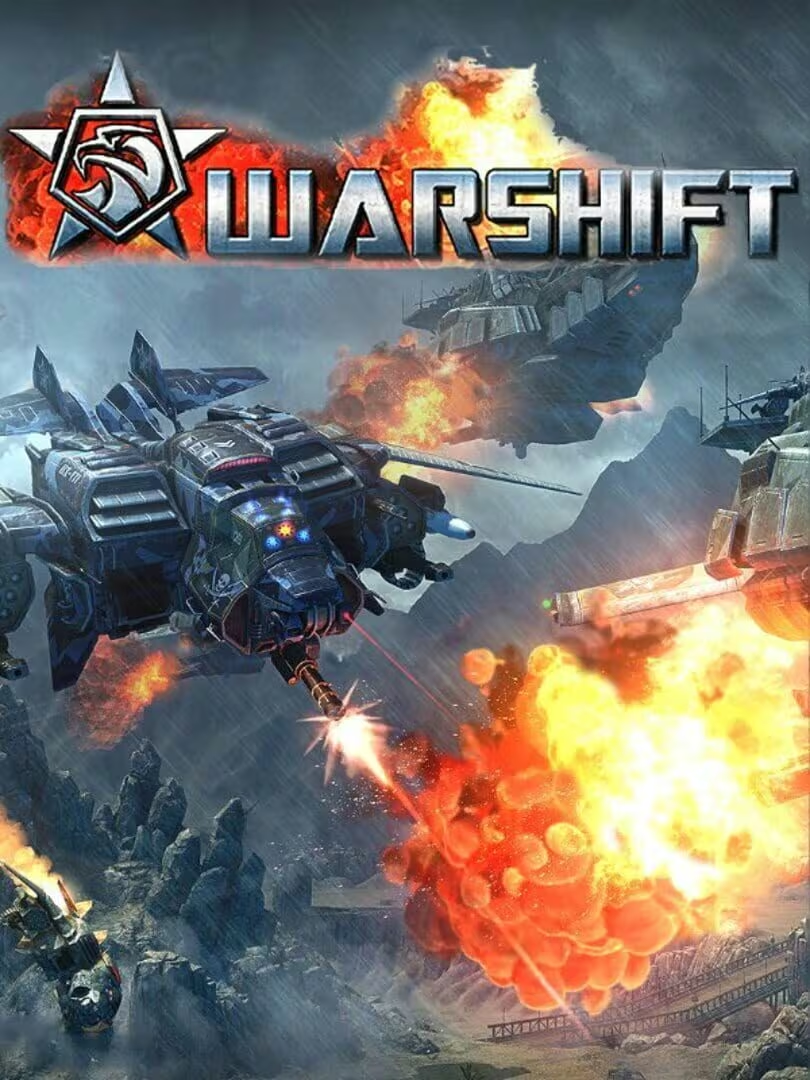 WARSHIFT
"Players manage unit survival and battlefield positioning to avoid defeat, though not a hardcore survival experience."
Last update: 01/06/2026