Deleveled similar games & best alternatives
Should you play it?
Master momentum in this unique jumping game that features no jump button! Preserve your potential energy and fall to new heights as you solve these clever puzzles and maneuver your way to victory.
What works
- Unique momentum-based puzzle mechanics
- Challenging and rewarding puzzle-platforming
- Multiple solutions per level
- Large number of levels and bonus content
- Minimalist, clean visual style
Things to keep in mind
- High difficulty and precision can cause frustration
- Repetitive chiptune music
- Star system requiring flawless runs can be stressful
- Minimal narrative or character expression
- Some performance issues reported
What to play next
Similar games, hidden gems, and fresh directions from this game.
Top picks
Games that feel the closest overall
Hidden Gems
Less popular games with surprisingly high similarity
If you liked…
Recommendations by what you enjoyed most
Similarity map
Explore nearby similar games and see why they’re close.
Deleveled: Less representative of its motivational profile, with noticeable differences. Motivations that often define this kind of title include Violence, Fantasy, Story, Thrill. Here, the score leans higher than usual among comparable games on Thrill. It leans lower than usual among comparable games on Relaxation, Expression.
Why this game works
A motivational profile of the game, with the closest similar game for each player motivation.
-
Autonomy
Game with the same Autonomy vibe
4"Players have freedom to explore multiple levels, experiment with mechanics, and choose their own puzzle-solving approaches."
 Paquerette Down the Bunburrows
"Players have freedom to solve puzzles in multiple ways and choose their own approach to levels."
-
Competence
Game with the same Competence vibe
5"The game demands high skill in puzzle solving, observation, and platforming, with complex challenges and rewarding feedback."
 Shipwrecked 64
"Game requires high skill in both puzzle solving and precise platforming execution, with feedback on performance via stars."
-
Competition
Game with the same Competition vibe
-3"Focus is on personal puzzle solving and mastery rather than competing against others."
 Safety First!
"Focus is on individual puzzle solving and mastery rather than competing against others."
-
Continuation
Game with the same Continuation vibe
3"Players report habitual play, repeated attempts on difficult levels, and motivation to keep playing despite frustration."
 Uncraft World
"Many players report habitual play and desire to keep progressing despite difficulty and frustration."
-
Cooperation
Game with the same Cooperation vibe
-5"Single player experience with no multiplayer or cooperative elements."
 A Story About My Uncle
"Single player experience with no multiplayer or cooperative elements."
-
Creativity
Game with the same Creativity vibe
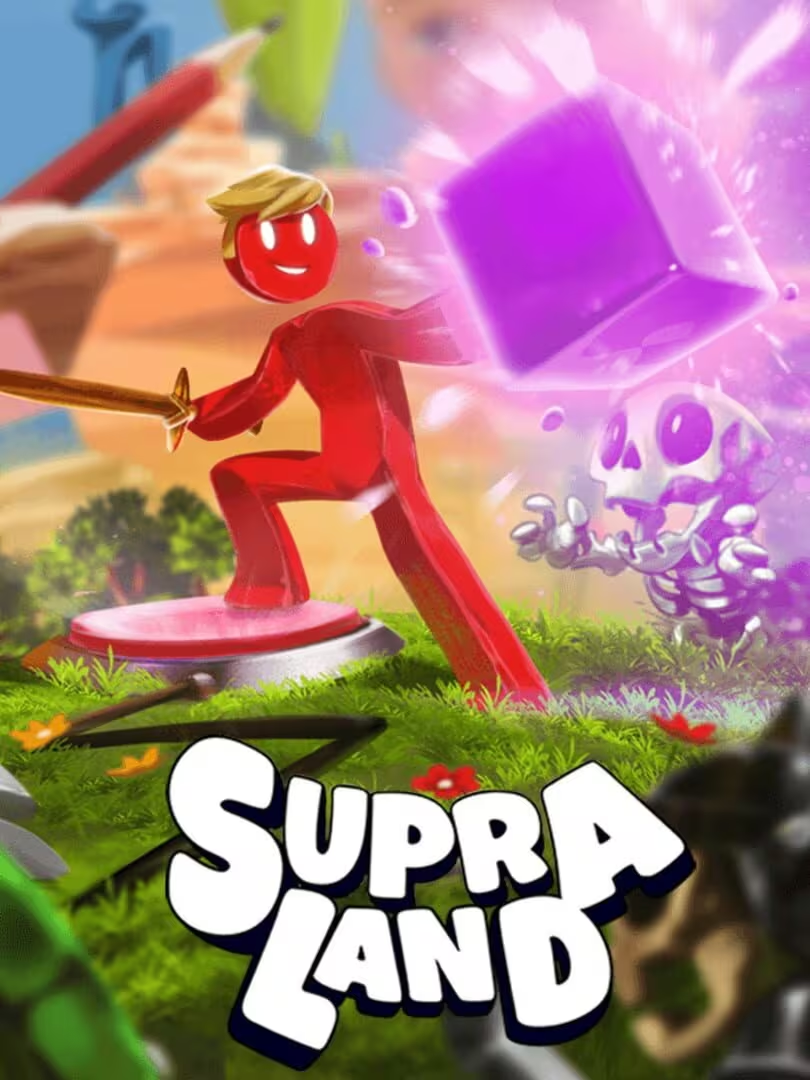
4"Players experiment with various tools and abilities to solve puzzles in multiple ways, encouraged to find creative solutions and explore hidden areas."
 Supraland
"Players encouraged to find creative and multiple solutions to puzzles."
-
Domination
Game with the same Domination vibe
-5"No elements of exerting control or superiority over others."
 Senren*Banka
"No elements of exerting control or superiority over others."
-
Escapism
Game with the same Escapism vibe
3"Players use the game as a challenging distraction and engaging mental exercise."
 Insider Trading
"Players use the game as a challenging distraction and mental engagement."
-
Expectation
Game with the same Expectation vibe
-4"Players engage voluntarily out of personal interest and intrinsic motivation."
 Paradiddle
"Players engage voluntarily out of interest and intrinsic motivation."
-
Experimenting
Game with the same Experimenting vibe
4"Game encourages trying different movements and strategies to solve puzzles."
Safety First!
"Game encourages trying different strategies and approaches to solve puzzles."
-
Exploration
Game with the same Exploration vibe
2"Some discovery involved in uncovering hidden levels and secrets, though mostly within known level designs."
 Offspring Fling!
"Some discovery of new mechanics and secret levels, but mostly within known level framework."
-
Expression
Game with the same Expression vibe
-4"Minimalist visuals with no character customization or self-expression features."
 Sokobond
"Minimalist visuals with no character customization or personal expression."
-
Fantasy
Game with the same Fantasy vibe
-5"Abstract, realistic puzzle mechanics without fictional or imaginative narrative elements."
 Hexologic
"Abstract, minimalistic, and realistic puzzle platforming without fictional narrative or roleplay."
-
Fellowship
Game with the same Fellowship vibe
-5"Solo play with minimal social interaction or community focus."
 Xanadu Next
"Solo play with minimal social interaction or community focus."
-
Growth
Game with the same Growth vibe
4"Players develop platforming skills and mastery of mechanics over time, with a clear difficulty progression."
 Pinkman
"Players develop problem-solving skills and platforming mastery over time."
-
Health
Game with the same Health vibe
-5"Sedentary gameplay with no physical activity component."
 GTR 2 FIA GT Racing Game
"Sedentary gameplay with no physical activity component."
-
Idle
Game with the same Idle vibe
-4"Requires constant focused attention and sustained effort; not suitable for casual or background play."
 The one who pulls out the sword will be crowned king
"Requires focused attention and repeated attempts; not suitable for casual or background play."
-
Intimacy
Game with the same Intimacy vibe
-5"No social or emotional relationship building."
 Five Nights at Freddy's 2
"No social or emotional relationship building."
-
Leadership
Game with the same Leadership vibe
-5"No leadership or group management roles."
 Getting Over It with Bennett Foddy
"No leadership or group management roles."
-
Progression
Game with the same Progression vibe
4"Players collect stars, unlock abilities, and progress through levels and modes."
 Oozi: Earth Adventure
"Players progress through levels, unlock bonus stages, and collect stars as achievements."
-
Relaxation
Game with the same Relaxation vibe
-3"Gameplay is tense and challenging, with frustration from difficulty spikes and limited saves."
 Delta Force — Black Hawk Down: Team Sabre
"Game can be frustrating and tense due to precision requirements and difficulty spikes."
-
Sensation
Game with the same Sensation vibe
2"Simple visual and auditory feedback with chiptune music; sensory stimulation is moderate and functional."
 Infinitode 2 - Infinite Tower Defense
"Simple visuals and chiptune music provide moderate sensory stimulation."
-
Status
Game with the same Status vibe
-4"No social recognition or leaderboard systems."
 Prince of Persia: The Forgotten Sands™
"No social recognition or leaderboard systems."
-
Story
Game with the same Story vibe
-5"No narrative or story elements; purely abstract puzzle gameplay."
 LYNE
LYNE
"No narrative or plot; purely abstract puzzle gameplay."
-
Strategy
Game with the same Strategy vibe
5"Heavy emphasis on logical reasoning, planning, and problem solving."
 Classic Sudoku
"Strong emphasis on logical thinking, planning, and problem solving."
-
Thrill
Game with the same Thrill vibe
3"Challenging platforming and the high-stakes final level provide moments of suspense and excitement."
 Yooka-Laylee and the Impossible Lair
"Some tension and excitement from challenging platforming and puzzle execution."
-
Value
Game with the same Value vibe
3"Players find good value in gameplay depth and challenge relative to price, though some note limited content."
 Aces Wild: Manic Brawling Action!
"Many players find good value in the amount of content and challenge for the price."
-
Violence
Game with the same Violence vibe
-5"No combat or destructive gameplay elements."
 To the Moon
"No combat or destructive gameplay elements."
-
Survival
Game with the same Survival vibe
-4"Stable environment with no threats or failure states; low risk and resource management."
 Retro Rewind - Video Store Simulator
"Stable environment without threat or resource management."
Last update: 01/06/2026