Sigils of Elohim similar games & best alternatives
Should you play it?
Sigils of Elohim is a free mini-game prelude to Croteam’s upcoming first-person puzzler The Talos Principle that challenges players to solve dozens of challenging sigil puzzles under the watchful eye of Elohim.
What works
- Free to play
- Challenging and engaging puzzles
- Calming and atmospheric music
- Unlockable rewards for the talos principle
- Pleasant minimalist graphics
Things to keep in mind
- Short overall length
- Lack of replay incentives or leaderboards
- No customization or narrative
- Some reward codes may not always work
- No settings options for audio or display
What to play next
Similar games, hidden gems, and fresh directions from this game.
Top picks
Games that feel the closest overall


Hidden Gems
Less popular games with surprisingly high similarity
If you liked…
Recommendations by what you enjoyed most
Similarity map
Explore nearby similar games and see why they’re close.
Sigils of Elohim: Broadly representative of its motivational profile, with a few distinct shifts. Motivations that often define this kind of title include Violence, Fantasy, Story, Thrill. It leans lower than usual among comparable games on Expression, Exploration, Creativity.
Why this game works
A motivational profile of the game, with the closest similar game for each player motivation.
-
Autonomy
Game with the same Autonomy vibe
4"Players freely choose how to place, rotate, swap, and manipulate pieces to solve puzzles without timers or forced routines."
 inbento
"Players freely manipulate and rotate tetromino pieces to solve puzzles with no forced routines."
-
Competence
Game with the same Competence vibe
3"Puzzle difficulty increases with levels, requiring skillful spatial reasoning and problem solving."
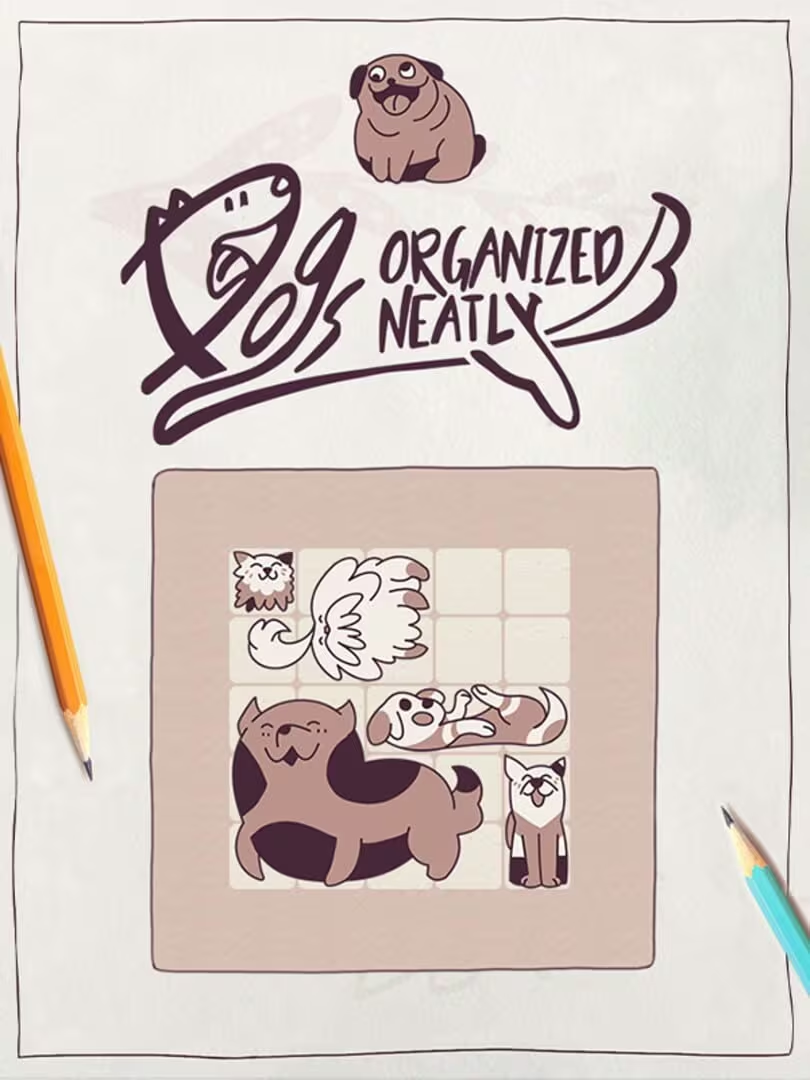 Dogs Organized Neatly
"Puzzles increase in difficulty requiring spatial reasoning and problem solving, providing skill challenge."
-
Competition
Game with the same Competition vibe
-3"Focus is on personal puzzle solving at own pace without leaderboards or ranked modes."
 Hatsune Miku Logic Paint S
"Focus is on personal puzzle solving at own pace; no leaderboards or direct competition."
-
Continuation
Game with the same Continuation vibe
2"Players engage in multiple short puzzle sessions; some find it addictive, others stop after completion."
 hocus
hocus
"Players report addictive 'just one more puzzle' effect and spend hours progressing through levels."
-
Cooperation
Game with the same Cooperation vibe
-5"Single-player puzzle game with no cooperative or multiplayer elements."
 Cogs
Cogs
"Single-player puzzle game with no cooperative or multiplayer elements."
-
Creativity
Game with the same Creativity vibe
-2"Players arrange predefined dog shapes; no creation or modification beyond placement and rotation."
Dogs Organized Neatly
"Players arrange given pieces but do not create or modify content beyond placement and rotation."
-
Domination
Game with the same Domination vibe
-5"No social or competitive dominance elements; purely personal puzzle experience."
 Save Room - Organization Puzzle
"No social or competitive dominance aspects; purely individual puzzle solving."
-
Escapism
Game with the same Escapism vibe
3"Relaxing music and engaging puzzles provide mental distraction and stress relief."
 KNIGHTS
"Relaxing music and meditative puzzle play provide distraction and mental engagement."
-
Expectation
Game with the same Expectation vibe
-4"Players engage voluntarily for enjoyment and mental exercise, not out of obligation."
 klocki
"Players engage voluntarily for enjoyment and brain exercise, not out of obligation."
-
Experimenting
Game with the same Experimenting vibe
2"Some trial-and-error and timing experimentation is needed to solve puzzles, encouraging trying new approaches."
 Zup! 4
"Some trial-and-error and strategy experimentation involved in solving puzzles."
-
Exploration
Game with the same Exploration vibe
-4"Gameplay occurs in fixed, familiar puzzle environments with no exploration or discovery."
 Zup!
Zup!
"Gameplay occurs in fixed puzzle boards with no new areas or discovery elements."
-
Expression
Game with the same Expression vibe
-5"No character or environment customization; standardized presentation focused on puzzle interaction."
 The Room
"No character or environment customization; standardized puzzle presentation."
-
Fantasy
Game with the same Fantasy vibe
-4"Realistic puzzle mechanics without fictional or imaginative narrative elements."
 Akin
Akin
"Realistic puzzle mechanics without fictional or imaginative narrative elements."
-
Fellowship
Game with the same Fellowship vibe
-5"No social or community features; strictly solo play."
 Outlast 2
"No social or community features; strictly solo play."
-
Growth
Game with the same Growth vibe
3"Players develop spatial reasoning and puzzle-solving skills as difficulty increases."
Dogs Organized Neatly
"Players develop spatial reasoning and puzzle-solving skills through increasing difficulty."
-
Health
Game with the same Health vibe
-5"Sedentary gameplay with no physical activity or health-related features."
 DRAGON BALL Z: KAKAROT
"Sedentary gameplay with no physical activity or health-related features."
-
Idle
Game with the same Idle vibe
-3"Requires focused attention to solve puzzles; not suitable for passive or background play."
 Polarity
"Requires focused attention to solve puzzles; not suitable for passive or background play."
-
Intimacy
Game with the same Intimacy vibe
-5"No social interactions or relationship building; purely individual experience."
 Return of the Obra Dinn
"No social interactions or relationship building; purely individual experience."
-
Leadership
Game with the same Leadership vibe
-5"No leadership or group management roles; single-player puzzle solving only."
 The Pedestrian
"No leadership or group management roles; single-player puzzle solving only."
-
Progression
Game with the same Progression vibe
3"Players progress through levels and categories, unlocking hints and achievements."
 Wordle
"Players progress through levels unlocking codes for rewards in The Talos Principle."
-
Relaxation
Game with the same Relaxation vibe
4"Calming music and gentle puzzle mechanics promote relaxation and stress relief."
 Mind Spheres
"Calming music and meditative puzzle solving promote relaxation and flow."
-
Sensation
Game with the same Sensation vibe
2"Pleasant visuals and soothing music provide moderate sensory enjoyment."
 Railbound
"Pleasant audio-visual presentation with soothing music enhances sensory enjoyment."
-
Status
Game with the same Status vibe
-5"No social recognition or status systems present."
 Resident Evil 7 Biohazard
"No social recognition or status systems present."
-
Story
Game with the same Story vibe
-4"No narrative or story elements; gameplay is context-free puzzle solving."
 0RBITALIS
"No narrative or story elements; gameplay is context-free puzzle solving."
-
Strategy
Game with the same Strategy vibe
3"Requires logical thinking, spatial reasoning, and planning to solve puzzles."
 PUSH
PUSH
"Solving puzzles requires planning and spatial reasoning strategies."
-
Thrill
Game with the same Thrill vibe
-3"No suspense or risk; gameplay is calm and predictable."
 Summer in Mara
"No suspense or risk; gameplay is calm and predictable."
-
Value
Game with the same Value vibe
5"Free game offering a polished, creative puzzle experience with good time value."
 20 Small Mazes
"Free game offering hours of challenging puzzles and unlockable rewards for another game."
-
Violence
Game with the same Violence vibe
-5"No violence or destructive gameplay; purely constructive puzzle solving."
 Linelith
"No violence or destructive gameplay; purely constructive puzzle placement."
-
Survival
Game with the same Survival vibe
-5"No threats or survival mechanics; stable, low-risk environment."
 100 hidden eternals
"No threats or survival mechanics; stable, low-risk environment."
Last update: 01/06/2026